Rod Serling: A Man on the Edge

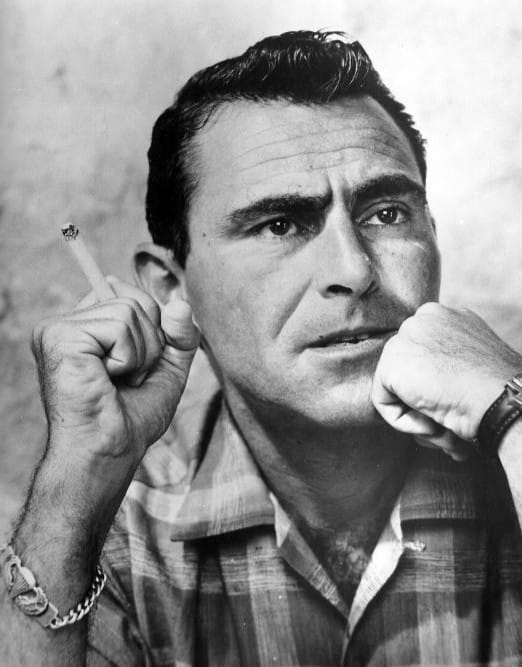
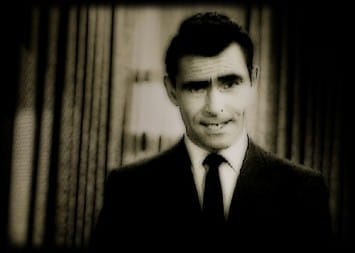
Imagine you're sitting on the couch, watching a TV series. You see a fairly peaceful scene, a child playing with his grandmother. The father and mother are also around. At some point, the camera pans to the right, and you see a man in a suit and tie staring directly at you, right into the camera. With a cigarette in his hand, he says:
As must be obvious, this is a house hovered over by Mr. Death, that omnipresent player to the third and final act of every life. And it's been said, and probably rightfully so, that what follows this life is one of the unfathomable mysteries, an area of darkness which we the living reserve for the dead — or so it is said. For in a moment, a child will try to cross that bridge which separates light and shadow, and of course he must take the only known route, that indistinct highway through the region we call the Twilight Zone.
-- The Twilight Zone, episode Long Distance Call
No one in today's storytelling would tell you all of this at the beginning of a TV episode, of course, but the fact remains that man in the suit and tie is one of the greatest screenwriters who ever lived. A man who, in his lifetime, conceived hundreds of different stories and brought them to the screen while maintaining outstanding quality; a man capable of creating stories that stir genuine emotion; a man who managed to poke at the very thing we human beings never want to be reminded of: that we are wretched. I'm talking about Rod Serling: a man... in the Twilight Zone.
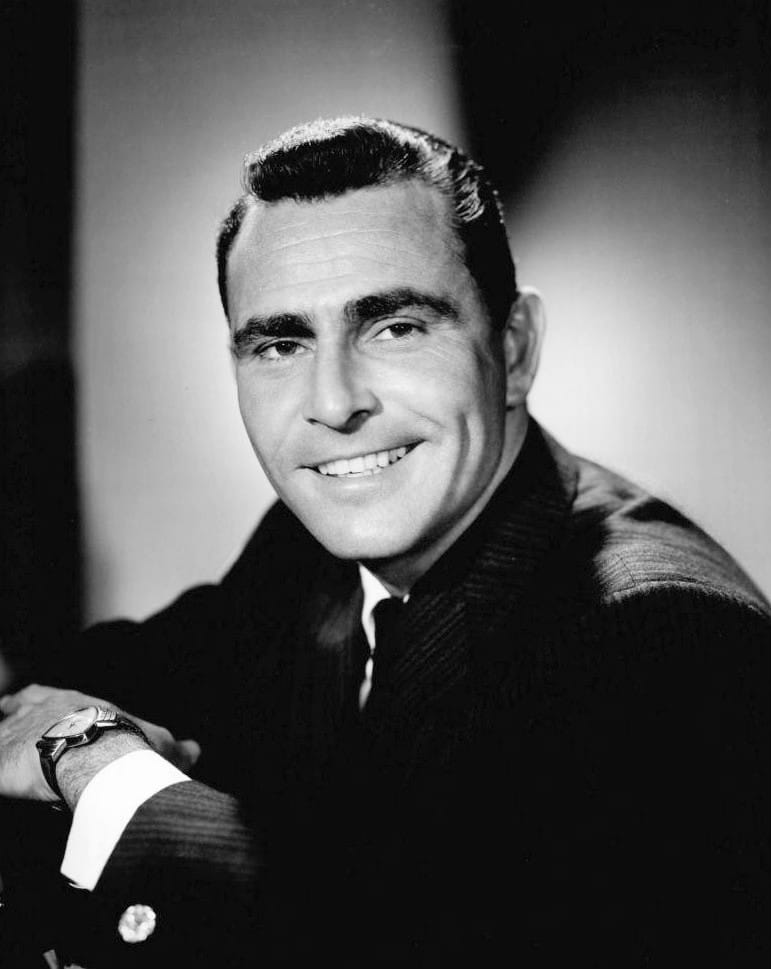
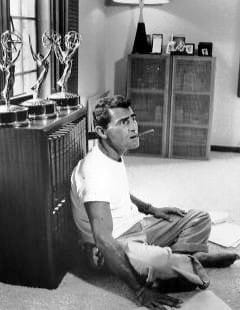
Alright, I admit I went too far. Rod wasn't a man in the Twilight Zone. Rather, the impression I've formed of him — by reading the testimonies of people who knew him — is that of a humble man: sincerely humble. He himself, once, contemplating his enormous shelf of plaques and trophies, wryly muttered, "God, how we honor ourselves." On top of that, we have many accounts of people who wrote him letters seeking advice on their stories: novelists, playwrights, and screenwriters. Rod always replied with kindness, and it's precisely here that his humility struck me the most. During an interview, Rod stated he worked fourteen hours a day, seven days a week, yet he always apologized to those who wrote him for not having replied sooner. Although Rod was not a man in the Twilight Zone, The Twilight Zone was a hugely successful TV series created by Rod.
Although Rod was not a man in the Twilight Zone, The Twilight Zone was a hugely successful TV series created by Rod.
How It All Began
I remember that as a child I wanted to be a deep-sea diver. I loved the idea not only of wearing a diving suit (the rigid outfit with the upside-down fishbowl on your head), but also of going down meter after meter underwater to discover what lies below. Then life took me elsewhere, and at this point I can't even swim. So much for being a deep-sea diver!
Rod, on the other hand, was fascinated by storytelling from an early age. He loved to talk and talk and talk. He always wanted to have someone in front of him to speak to — or, to put it more accurately: someone to use as an audience for his monologues. And unlike the deep-sea diver dream, that's what he cultivated his entire life. His parents remembered a long car ride during which they had bet on how long Rod could talk by himself. He never stopped, not even when they arrived at their destination.
Rod did nothing but write stories his whole life: stories for TV shows, stories for novels, stories for radio, stories for short fiction, and even stories for advertising.
A Medium to Explore
We're in America, right after the Second World War. Only recently have people started to see, exclusively in bars or hotels, glowing rectangles that showed movies: a sort of micro-cinema in a box. I'm obviously referring to television. Until then, people were used to going to the movies only sporadically, while during their daily lives they could ease their boredom by listening to the radio. Radios were a fundamental part of anyone who wanted to pass the time without getting bored, and they commanded a great reputation — so much so that they even broadcast programs with structured scripts, that is, with stories thought out and performed with voice and sound effects; so much so that sponsors invested plenty of money in them. Rod began his career in this scenario: a highly popular medium like the radio about to be replaced by an even more powerful medium like television. It goes without saying that the sponsors rubbed their hands together like flies, with the same expression I make when instead of buying tomatoes I come home with a six-pound jar of chocolate.
Rod at that time was working as a staff writer for a radio station, but he was far from satisfied. For him, radio "ate up ideas" that could have been reused, adapted for other stories or perhaps for other media, but were abandoned because they were locked under copyright.
From a writing point of view, radio ate up ideas that might have put food on the table for weeks at a future freelancing date. The minute you tie yourself down to a radio or TV station, you write around the clock. You rip out ideas, many of them irreplaceable. They go on and consequently can never go on again. And you've sold them for $50 a week. You can't afford to give away ideas — they're too damn hard to come by. If I had it to do over, I wouldn't staff-write at all. I'd find some other way to support myself while getting a start as a writer.
-- Rod Serling's Wikipedia page
He also felt he wasn't using his full potential.
Radio, in terms of ... drama, dug its own grave. It had aimed downward, had become cheap and unbelievable, and had willingly settled for second best.
-- Rod Serling's Wikipedia page
In his view, very few radio writers would be remembered for their contributions. And so, Rod decided he would work for television.
A Medium to Destroy
As his television career progressed, Rod began to have misgivings about how things were evolving. First of all, he didn't like the way commercials were inserted in the middle of shows. They made all the emotional charge he poured into those stories decay. Rod told sponsors they should see TV as a platform for dramatic entertainment, capable of tackling important themes and subtle meanings, rather than as "an animated billboard." He got angry:
How can you put out a meaningful drama when every fifteen minutes proceedings are interrupted by twelve dancing rabbits with toilet paper? No dramatic art form should be dictated and controlled by men whose training and instincts are cut of an entirely different cloth. The fact remains that these gentlemen sell consumer goods, not an art form.
-- Rod Serling's Wikipedia page
For the sake of transparency: I looked everywhere online for that dancing-rabbits commercial, and I couldn't find it. I think it was one of his gags, thrown out on the spot. Besides, Rod himself wrote commercials for TV, and it seems he didn't enjoy it much:
As I recall, there was a drug, a liquid drug, on the market at the time that could cure everything from arthritis to a fractured pelvis, and I actually had to write testimonial letters. And on that particular day I had just had it.
-- Rod Serling Memorial Foundation
Secondly, a far bigger problem than rabbits with toilet paper: screenwriters had no freedom to tell the stories they wanted.
In Requiem for a Heavyweight, a film about the drama of a boxer forced to retire from boxing due to age, Rod was made to remove the line "Got a match?" because one of the sponsors backing the project was Ronson — a company that has been selling beautiful lighters for years, which I would certainly have bought if I hadn't quit smoking, but which unfortunately didn't sell matches at the time.
There were many such demands, Rod said. Some could be insignificant, like the automaker Ford asking to remove the Chrysler Building — a skyscraper that symbolized the great success of the Chrysler family; or the network asking to make a Coca-Cola bottle disappear because "it had Southern connotations." Others, however, were unreasonable, and Rod received one that he simply couldn't swallow.
In 1955, an African-American man from Mississippi was accused of having offended a white woman right in her grocery store. This accusation, whether true or not, cost him his life; he was kidnapped, tortured, and drowned in a river. The marks of his suffering were shown to everyone during his funeral, with the casket left open throughout the entire ceremony, and he became a symbol of the persecution of African Americans in America. His name was Emmett Till, and he was fourteen years old.
Rod was deeply affected by the case because it touched on the very ideal of equality in which he passionately believed, and as he always did in his screenplays, he wanted to channel that emotion into a story: Noon on Doomsday. Rod stated that the entire story was inspired by the Emmett Till case, but the sponsor and the network, after his statement, decided such a project could not go forward. A journalist wrote about the affair:
"Playhouse 90" and Mr. Serling had to fight executive interference before getting their play on the air last night. The artists in Hollywood are proud of their position in favor of the viewing public.
-- Rod Serling's Wikipedia page
In an interview, Rod elaborated:
It was a story that attempted to dramatize the aftermath of the kidnapping in Mississippi of the Till boy, the young Negro out of Chicago. I wrote the script originally with white and Negro characters, then it was changed to make it the case of an unidentified foreigner. Then the locale was moved from the South to New England, and I'm convinced they would have gone up to Alaska or the North Pole and used Eskimos as the minority if it weren't for the costume problems. What came out in the end was a lukewarm, empty, castrated show.
Rod couldn't take it anymore. Yet another story that couldn't say what its creator wanted to say, that couldn't impress upon the audience the same emotions its author had felt firsthand:
I don't want to fight anymore. I don't want to have to battle sponsors and agencies. I don't want to have to push for something that I want and have to settle for second best. I don't want to have to compromise all the time, which in essence is what the television writer does if he wants to put on controversial themes.
-- Rod Serling's Wikipedia page
No medium of communication was under the spotlight like television. It seemed to be the root of all evil, and among those who demonized it — besides parents, teachers, and certain religious groups — there were, of course, the newspapers. They feared that television would steal a large segment of users who, not feeling like reading, would simply watch TV. Rod obviously pushed back against this demonization.
Finally, Rod tells us about a behavior that most screenwriters of the time adopted. There was a pervasive fear of having inadvertently included details in stories that might be targeted by the sponsor or the networks. Writers made their stories flat and bland just to avoid any friction with the networks, and all of this happened spontaneously, automatically. In practice, the screenwriters censored themselves before anyone had even told them that a particular detail couldn't be put on screen — as if it were a self-censorship, or as Rod called it: "pre-censorship."
The Twilight Zone
Tired of the problems plaguing television, Rod decided to take the big leap — the leap that brought him not only immense fame in the world of screenwriting, but also the ability to put his real thoughts on screen exactly as he wanted to show them. He had noticed a small detail that had gone unnoticed by most writers: TV didn't censor the fantastic, fantasy, or science fiction. Sponsors certainly had qualms about associating their products with stories depicting racial crimes or murders of any kind; but at the same time, if the one discriminating or killing was an extraterrestrial, their products' image wouldn't be compromised.
And so The Twilight Zone was born. An anthology TV series (meaning each episode contains its own self-contained story) for which Rod wrote about a hundred episodes out of roughly one hundred and fifty-six total. That's right — nearly seventy percent of the entire series.

I found that it was all right to have Martians saying things Democrats and Republicans could never say.
-- Interview with Mike Wallace
Why Is It So Important?
At first glance, you'd hardly call it "profound." The premises are utterly simple: for example, in the first episode you see a man who discovers he's alone on Earth, or in the episode "The Mighty Casey" we're told how a failing baseball team manages to make a comeback thanks to an absurdly strong player. All premises that don't hint at great twists: the man might find people and discover he isn't alone after all, or realize that he truly is; and the baseball team could just as easily stay last in the standings as it has been for years, or it could win.
So what makes this series fascinating? I generally always distinguish between good stories "because the context is fascinating" and good stories "because the character is fascinating" — that is, story-driven or character-driven. In the case of The Twilight Zone, we're immediately presented with story-driven situations, like the man who finds himself alone: the situation has forced him there. The man could face survival choices; he could run out of food, or even worse, water. He might need urgent medical care or shelter. But Rod doesn't talk about any of that. That episode doesn't show survival; it isn't merely story-driven. That man is desperate about being alone because he loved going to the bar and drinking; he's desperate because he can no longer dance with people; because he can no longer talk to anyone who will listen. This is his true tragedy. That episode shows loneliness. The story doesn't revolve only around the strange fact of being alone in the world, but around the protagonist's emotional state when confronted with the awareness of being alone.
This is the series' true strength: showing an absurd scenario in which the characters react so humanly that you think you would have made the same choices in that situation, and as a result it throws in your face that you're nothing more than a human being, and that your life depends on everyone else's. You're not special. You're wretched.
How It Achieved This
But to accomplish such a grand task, there was a need for decision-making power. There was a need to have control over one's own stories. And so Rod's production company was born: Cayuga Productions. Then there was also a need for a good number of talented screenwriters, and so Rod decided to bring a couple of well-known faces of the time into Cayuga. Nothing extraordinary: just Charles Beaumont and Richard Matheson. The former contributed to 22 episodes of The Twilight Zone, and during his career also wrote the screenplay adaptation of Edgar Allan Poe's story The Masque of the Red Death. The latter wrote stories like I Am Legend and I Am Helen Driscoll — and if you don't know them, I'd suggest you first go to confession, and then put your life on hold for three months and catch up on all of his works. In short, Rod just picked the first two gentlemen who happened to be walking by his house.
Of course, Cayuga couldn't follow the usual standards of production companies. The rules were clear: no cuts to stories because of sponsors; yes to reusing scenes and elements already conceived for other stories; complete creative freedom for those who would create those stories. It was a free place where every storyteller dreamed of working, a completely new vision of the narrator's craft. Richard Matheson said that at the heart of the production lay a meticulous attention to detail:
We had three-day rehearsals, for God's sake, where we sat around tables with actors and directors, and discussed the show. That's still very rare in television.
-- Richard Matheson interview
How It Evokes Genuine Emotion
These working methods ensured that every episode showed exactly what its writer wanted to express. Indeed, every episode written by Rod seems to carry a small piece of the life he himself lived, no matter how painful.
In the episode "The Night of the Meek," a philosopher is embittered by the fact that Christmas should be a day for doing good to others, while in reality it has become a day for thinking only about receiving gifts. On top of that, his destiny after having studied philosophy seems to be to remain poor and jump continuously from one job to another trying not to starve. The last odd job he's found is dressing up as Santa Claus and entertaining children, but this work makes him suffer to the point that he shows up completely drunk, only to be immediately fired.
In 1929, America experienced the Great Depression, an economic crisis lasting ten years that spread from the United States to the whole world. During that period, a third of American farmers lost their land and 25% of the entire country was unemployed. At the time, Rod was five years old.
I like to imagine that with this episode Rod wanted to evoke the moments he lived through during those years — especially since December 25 is not only Christmas but also his birthday.
Lieutenant Fitzgerald discovers he has a power that no man at war would ever want: knowing which men will die in the next operation. To know who will meet that unjust fate, he simply has to look them in the face, and if the unfortunate soul is next in line for the eternal sleep, a shadow will fall over his face. Afflicted by this knowledge, he spends an entire day looking at the faces of all forty-four of his comrades, one by one, writing down the names of those next to die. As predicted, they do indeed die the next day.
Infantry platoon, U.S. Army, Philippine Islands, 1945. These are the faces of the young men who fight, as if some omniscient painter had mixed a tube of oils that were at one time earth brown, dust gray, blood red, beard black, and fear — yellow white, and these men were the models. For this is the province of combat, and these are the faces of war.
— Opening narration, "The Purple Testament"
These are the premises of the episode "The Purple Testament," and Rod talks about it for a very specific reason: he was exactly where Lieutenant Fitzgerald is — in the Philippines, on the island of Leyte — and he fought the same war: the Second World War. War became a very sensitive subject for Rod, because in high school he had pushed his classmates to enlist — partly through the school newspaper, of which he was an editor — while after having fought and seen with his own eyes who survives and who doesn't, Rod chose to advocate for peace.
I was bitter about everything and at loose ends when I got out of the service. I think I turned to writing to get it off my chest.
I won't discuss every episode, but I strongly recommend watching them. Furthermore, Marc Scott Zicree, a friend of Rod's, analyzed every episode and wrote the greatest companion to the series: The Twilight Zone Companion. It took him years, and it's still worth reading.
In short, every episode has at its core a deeply human emotion. Every episode succeeds in the purpose of seeing us from above, as if we were being filmed by a surveillance camera — exactly as if aliens were observing us to understand something that, to their eyes, is too complex to be understood. Except those aliens are ourselves.
The End
During the fourth season of The Twilight Zone, Rod took a break. He left everything to his screenwriters, signed off on only seven episodes of the fourth season, and went to teach at Antioch College in Ohio. During the 1962–63 academic year, he taught courses on writing and playwriting, but the most striking course that caught my eye was "social and historical implications of media." Although this may be my own assumption and I haven't found any direct testimony, I like to think that course was created deliberately as his final jab at censorship. A necessary revenge.
After five years of productions and having created 156 episodes, Rod decided the series would be discontinued. The budget he had invested was enormously high, while the revenue had been scant. Unable to recoup his losses or save Cayuga, he had to sell the rights to CBS, which holds them to this day.
How Rod Influenced Storytelling
His legacy in the world of narrative is immense. Over the years, many anthology TV series with a science fiction (and fantasy) bent have followed, drawing inspiration from his work. Tales from the Loop comes to mind — a collection of small anthology stories that share a common city. Every "anomaly" happens unknown to the other inhabitants, and the dust is swept very neatly under the rug, but the lives of those who live in that city intersect even across different episodes. What it has in common with Rod's stories is the magnificent philosophical reflection that every single episode aims to convey.
Another TV series that clearly takes inspiration is Love, Death and Robots, which oscillates between ironic and tragic episodes, reflective and clever, with the unique feature that each story is presented in very different visual styles: from the realistic 3D typical of modern animated films, to stop-motion miniatures, to live-action footage. Certainly a worthy successor that isn't afraid to innovate, just as Rod did.
What Rod Leaves Us
In the end, Rod has been an immense source of inspiration for me. Not only for his boundless creativity, but also for his thoughts and convictions, for his strong inclination toward good and justice, and for the humility he always carried with him. A man who succeeded in telling stories that said something about humanity, while at the same time maintaining a humility worthy of a human being.
The ultimate obscenity is not caring, not doing something about what you feel, not feeling! Just drawing back and drawing in, becoming narcissistic.
Finally, Rod taught me that you can win even through compromise; that if what you want to do is only possible by accepting certain limitations, it is right to work your hardest, to prove that even burdened by those limitations you've reached your goal — but also that precisely because of them you've managed to do even more: to surpass the limit. And most importantly: those goals were reached because there was something authentic to give, something that goes beyond admiration or approval, money or fame — something that touches what is most authentic in us, most alive, most human: emotions.
Thank you, Rod. Greetings from the Twilight Zone.
If what you've read made you passionate, inspired you, made you think, made you want to tell stories, write, or simply made you sick, you can support this project with a donation. Even a small one. Even a symbolic one. It will make a difference.
Notes
Thanks to Denise, Francesca, and Dino for giving me advice on this piece.
Related Works and Other Interesting Stuff
- Most interesting episodes of The Twilight Zone (in my opinion):
- "The Monsters Are Due on Maple Street" — Season 1, Episode 22
- "One for the Angels" — Season 1, Episode 2
- "The Lonely" — Season 1, Episode 7
- "Judgment Night" — Season 1, Episode 10
- "People Are Alike All Over" — Season 1, Episode 25
- "Execution" — Season 1, Episode 26
- "The Mighty Casey" — Season 1, Episode 35
- "Eye of the Beholder" — Season 2, Episode 6
- (TV Series) - Tales from the loop
- (TV Series) - Love, Death and Robots
- (TV Series) - Solos
- (Book) - Patterns, Rod Serling - Contains four screenplays: Patterns, The Rack, Old Macdonald Had a Curve, and Requiem for a Heavyweight. The first two launched Rod into the pantheon of great television screenwriters.
- (Book) - The Collected Stories of Richard Matheson — Vol. 1, Vol. 2 — sometimes they're unavailable, but they regularly come back. Otherwise, many used copies can be found on eBay.
- (Film) - The Truman Show
- (Videogame) - Life is Strange
Fonti
- OUTTAKES: That Serling Stamp
- Roasting Rod Serling
- Rod Serling Wikipedia
- Why is tv the whipping boy?
- How they write a script: Richard Matheson
- Rod Serling rips TV censorship
- Cited episodes of The Twilight Zone:
- "Where Is Everybody?" — Season 1, Episode 1
- "The Purple Testament" — Season 1, Episode 19
- "Long Distance Call" — Season 2, Episode 22
- "The Night of the Meek" — Season 2, Episode 11